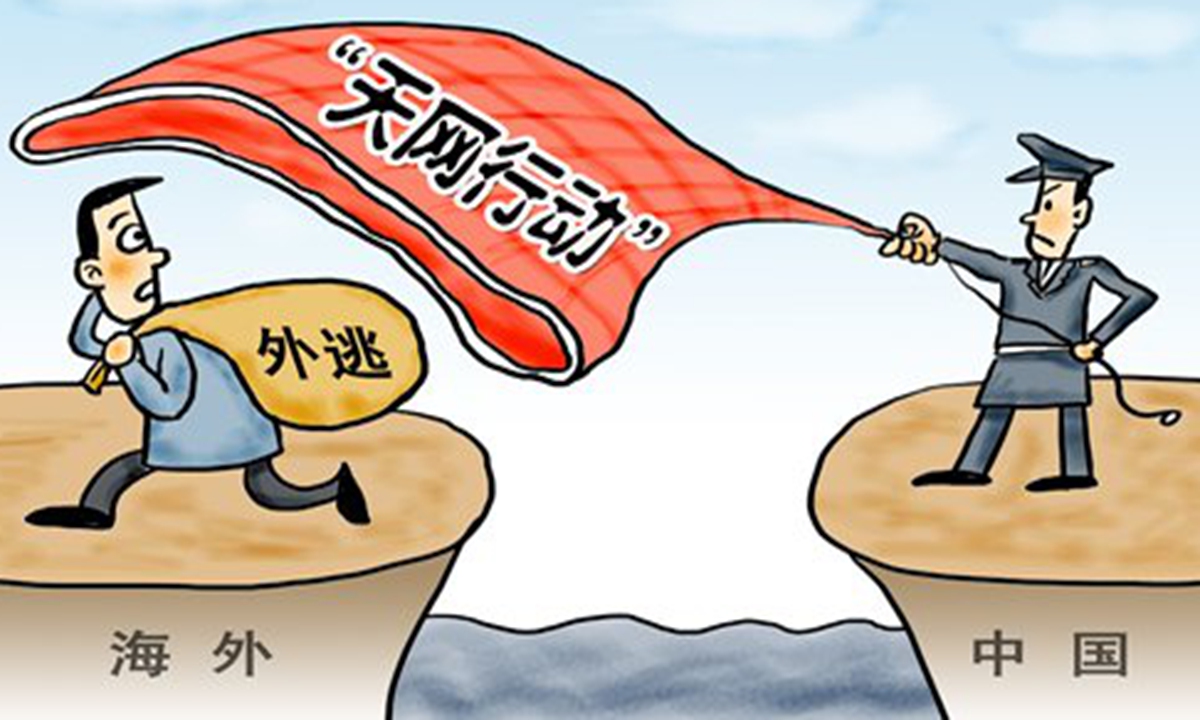
An animated picture features Chinese law enforcement official tracking back a fugitive who flees overseas with his ill-gotten asset during the Skynet operations, China's project to track down fugitives. Photo:VCG
Chinese lawmakers began reviewing a draft law on combating cross-border corruption on Tuesday, a legislation which experts believe would help close legal gaps in investigating overseas corruption, pursuing fugitives and recovering illicit assets, while strengthening international cooperation and corporate compliance.
The draft was submitted for its first reading to the ongoing session of the Standing Committee of the National People's Congress, the country's top legislature, per Xinhua News Agency.
Huo Zhengxin, a professor at the China University of Political Science and Law, told the Global Times that the draft law represents a dedicated piece of legislation within China's anti-corruption legal framework and a major step forward in the country's law-based governance of foreign-related affairs. It will fill a legislative gap in combating cross-border corruption, Huo said.
As Chinese companies expand business overseas, cross-border corruption cases face challenges in obtaining evidence abroad, pursuing fugitives and recovering illicit assets. Existing anti-corruption laws have faced limitations in addressing such cases involving foreign affairs, making such dedicated legislation necessary, Huo said.
Structured into six chapters and 47 articles, the draft sets out the principles, scope and key provisions underpinning China's efforts to combat cross-border corruption. It also defines relevant operational mechanisms and institutional responsibilities, and seeks to strengthen case handling and international cooperation.
The draft further clarifies enterprises' obligations regarding integrity and compliance, and specifies legal liabilities for violations.
As one of the experts involved in drafting the legislation, Huo said a key innovation of the draft is to strengthen international cooperation and corporate integrity and compliance obligations. As evidence, suspects and illicit assets in cross-border corruption cases are often located overseas, the draft provides mechanisms including extradition, mutual legal assistance and repatriation, while aligning with relevant rules under the UN Convention against Corruption (UNCAC), said the expert.
The draft also makes clear that Chinese companies operating overseas, including both state-owned and private enterprises, have legal obligations to uphold integrity and compliance with domestic laws, Huo said.
The legislation would also codify practices accumulated through China's past campaigns against cross-border corruption, such as Sky Net and Fox Hunt operations, turning them into a more systematic legal framework and strengthening the law's deterrent effect, according to Huo.
The draft law is a practical step to regulate the development of cross-border businesses and help build a world-class business environment aligned with market principles, the rule of law and international standards, Xinhua noted.
It is also expected to expand the legal tools available to combat cross-border corruption and help address challenges in detecting corruption, collecting evidence, recovering illicit assets and securing convictions, according to the report.
In January, CCTV News reported on the case of a former senior executive of China National Offshore Oil Corporation, who was accused of accepting large amounts of bribes that were concealed overseas, with a businessman allegedly acting as a "front" to collect the illicit payments.
The draft's explicit corporate integrity and compliance requirements would make it harder for individuals to disguise bribery and other corrupt practices through overseas projects in an attempt to circumvent domestic oversight, while further clarifying the extraterritorial reach of China's anti-corruption laws, Huo said.
The draft also contains provisions to counter the use of foreign countries' domestic anti-corruption laws to exercise "long-arm jurisdiction" over Chinese companies, which Huo described as another important innovation in China's foreign-related legal framework.
China has been deepening its efforts in international anti-corruption cooperation, with 963 corrupt fugitives repatriated to the country in 2025, according to a work report from the country's top anti-graft body, Xinhua reported.
C | 沃什本周将发表重要讲话 根据日程安排,2026年杰克逊霍尔全球央行年会将于8月27日至29日在美国怀俄明州举行,会议主题为“金融创新:对支付与政策的影响”。 沃什将于北京时间8月28日晚上10点在年会上发表重要讲话。
D | 沃什此前表示,他希望利用这次演讲来界定美联储面临的“重大问题”——包括对通胀目标、生产力、人口结构变化以及全球经济冲击的担忧。 投资者期待沃什阐明美联储未来将如何应对顽固通胀,但目前尚不确定他是否会给出明确表态。迄今为止,沃什一直回避给出任何前瞻性政策指引。 道明证券策略师表示,从理念上,沃什本就不愿给出政策指引,预计沃什不会改变其解读经济前景的表态方式。市场将寻找有关其政策反应函数的线索,同时期待他重申美联储对抗通胀的立场。 彭博经济学家预计,沃什更可能重点讨论其美联储改革的理念框架,强调前瞻指引可能降低政策灵活性,并干扰市场信号。 而在此之前,美国国债市场遭遇猛烈抛售,美国30年期国债收益率一度升至5.337%,创下2007年6月以来新高。随后,美国财政部紧急宣布,将10年至30年期美债的流动性支持回购操作规模至少提高一倍。
F | 在全球央行年会召开前,美联储“最青睐的通胀指标”美国7月PCE通胀数据将于北京时间8月26日20:30公布,若该数据超出市场预期,市场对9月美联储的加息预期或将再度升温,进而引发美债收益率与全球风险资产联动波动。此外,美国二季度实际GDP修正值也将于当天20:30公布。 财报季的重头戏 美股财报方面,根据日程安排,英伟达将于北京时间8月27日凌晨发布截至7月的季度财报,全球AI资本开支周期将迎来“终极验证”,或将引发市场巨震。 据杰富瑞最新发布的报告,预计英伟达本财季收入将达到950亿美元,高于市场一致预期的约919亿美元;下一财季收入指引有望达到1080亿美元,也高于市场预期的约1037亿美元。 另有分析指出,真正决定英伟达股价弹性的是三个更长期的问题:Rubin能否顺利接棒Blackwell、AI需求是否仍显著大于供给,以及英伟达为锁定未来需求需要承担多大的融资和资产负债表责任。 杰富瑞认为,英伟达Rubin的爬坡速度可能显著快于Blackwell初期。原因在于Rubin延续72-GPU Oberon NVL72机架形态,能够复用GB200、GB300积累下来的液冷数据中心部署和制造基础。 摩根士丹利指出,融资、市场份额和毛利率是投资者当前最关注的三大争议点。
G | 英伟达管理层大概率会强调这些结构有助于加速AI基础设施建设,但投资者需要看到更清晰的会计披露,包括或有义务、租赁和电力支付支持、残值承诺等细节。 另外,中东局势依然是重要且不可控的场外因素。 根据此前预告,美国财长贝森特将于当地时间周一美股盘中(北京时间周二凌晨)举行新闻发布会,披露美国对伊朗实施“前所未有的经济孤立”措施的细节。 目前市场尚不理解美国如何在军事打击都未能奏效的情况下,通过加码经济制裁逼迫伊朗妥协。
H | 伊朗最高国家安全委员会秘书雷扎伊8月22日公开表示,任何参与对伊朗实施经济限制的国家,都被伊朗视为敌人。同时,美国在霍尔木兹海峡南部航道的任何行动都将成为伊朗的打击目标,且伊方将打击美国与该地区任何反伊朗势力举行的会晤。 Rystad能源石油市场分析副总裁亚尼夫·沙阿表示:“外交斡旋看不到明显进展,全球能源市场再度计入外交谈判失败的风险。” (文章来源:券商中国)。
Current article:http://3uknz.linxiuhuaishuangniuzhenrua.bond/news/20260826_540114.html


